LED Face Masks: What They Are, How They Work and What the Research Says
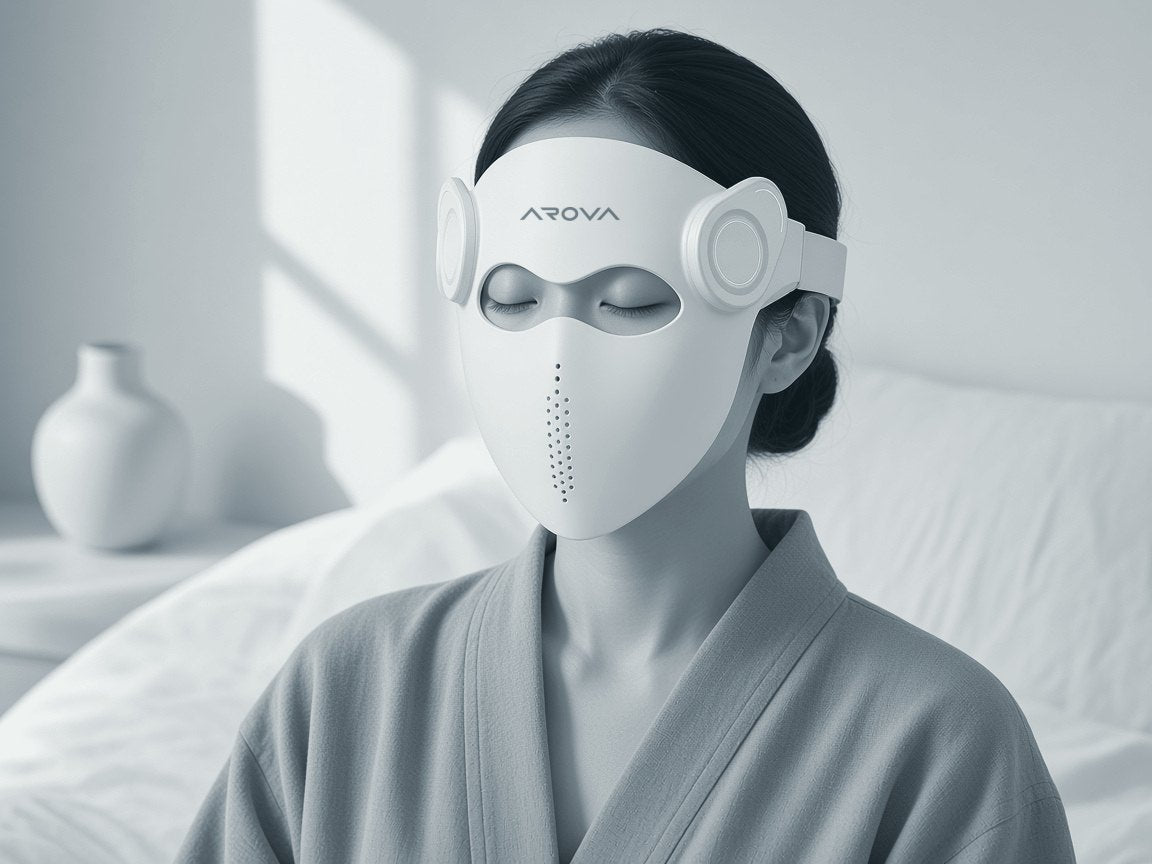
By The Arova Team · Updated 11 October 2026 · 9 minute read
An LED face mask is a wearable shell set with light-emitting diodes that shine narrow bands of red, near-infrared or blue light onto the skin. Do LED face masks work? Researchers have published a meaningful body of work on how skin absorbs red and near-infrared light, and reviews describe LED light as generally well tolerated. They are equally clear that studies vary widely, that home devices are less studied than clinical equipment, and that more work is needed. This guide, written in Australia, sets out that evidence in the researchers' own words.
In brief
- An LED face mask delivers low-level, non-heating light at set wavelengths, usually red, near-infrared and sometimes blue.
- The most studied idea is that cells absorb this light in their mitochondria.
- Published reviews describe LED light as well tolerated, with few significant adverse events.
- The same reviews point to small studies, varied settings and limited long-term data.
- Eyes deserve care with any bright light, and some medicines increase light sensitivity.
What is an LED face mask?
LED stands for light-emitting diode: a small, efficient electronic light source that gives off a narrow band of colour. An LED face mask arranges many of these diodes inside a shell shaped to the face, so light reaches the forehead, cheeks, nose and jaw evenly and at a consistent distance.
The field of research behind these masks is usually called photobiomodulation, or PBM. It describes the study of how low-level red and near-infrared light interacts with living cells. "Low-level" is the important phrase. This is not the light used to cut, resurface or heat tissue. It is gentle, non-thermal light, intended to be absorbed rather than to warm.
LEDs were not always the light source of choice. A 2018 review by Heiskanen and Hamblin in Photochemical & Photobiological Sciences traces the history: "Scientific research into PBM was initially started in the late 1960s by utilizing the newly invented (1960) lasers." Over time the field broadened: "However in recent years, non-coherent light sources such as light-emitting diodes (LEDs) and broad-band lamps have become common."
The same authors explain why the LED face mask exists at all: "Advantages of LEDs include no laser safety considerations, ease of home use, ability to irradiate a large area of tissue at once, possibility of wearable devices, and much lower cost per mW." Their closing line is simple: "LED photobiomodulation is here to stay."
How does an LED face mask work? The science of light and skin
Light can only influence a cell if something in that cell absorbs it. Much of the research focuses on the mitochondria, the structures often described as the cell's energy centres.
A 2013 review from the Wellman Center for Photomedicine at Massachusetts General Hospital, published in Seminars in Cutaneous Medicine and Surgery, puts it this way: "The photons are absorbed by mitochondrial chromophores in skin cells." The authors add an observation many people find surprising: "Although skin is naturally exposed to light more than any other organ, it still responds well to red and near-infrared wavelengths."
Later work narrowed this down. Michael Hamblin's 2018 review in Photochemistry and Photobiology states that "The primary site of light absorption in mammalian cells has been identified as the mitochondria and, more specifically, cytochrome c oxidase (CCO)."
An earlier review by de Freitas and Hamblin explains why this enzyme matters. Cytochrome c oxidase "contains both heme and copper centers and absorbs light into the near-infra-red region," and "The leading hypothesis is that the photons dissociate inhibitory nitric oxide from the enzyme, leading to an increase in electron transport, mitochondrial membrane potential and ATP production." ATP is the molecule cells use to carry energy.
Note the word hypothesis. The same authors are candid that the field "has been known for almost 50 years but still has not gained widespread acceptance, largely due to uncertainty about the molecular, cellular, and tissular mechanisms of action." That is the honest state of play, and it is worth knowing before you read any marketing.
Red, near-infrared and blue: LED face mask wavelengths explained
Wavelength is measured in nanometres (nm), and it decides the colour of the light and how it behaves in skin. Consumer LED face masks commonly list some combination of the following.
| Light | Typical range | What to know |
|---|---|---|
| Red | roughly 620–700 nm | Visible red glow. The most studied colour in this field. |
| Near-infrared | roughly 800–900 nm | Largely invisible to the eye. Often paired with red. |
| Blue | roughly 400–490 nm | Visible blue. Studied separately, and the colour reviewers treat with most caution around the eyes. |
A red light face mask typically combines red and near-infrared diodes, and that pairing is what most of the mechanism research above describes. Some masks add blue, amber or other colours. More colours on a box does not by itself tell you much. The wavelength, how much light reaches the skin (irradiance) and session length matter more than the number of modes, and many brands do not publish all three.
Do LED face masks work? What the research says, and what it doesn't
This is the question most people search for, and it deserves a careful answer rather than a quick one.
The research base is real and growing. A 2018 systematic review in Lasers in Surgery and Medicine by Jagdeo and colleagues analysed thirty-one randomised controlled trials of LEDs in dermatology and described LEDs as "an emerging modality to alter skin biology." The 2013 Wellman Center review concluded that "The noninvasive nature and almost complete absence of side effects encourage further testing in dermatology."
The research is also uneven. The same 2018 review flagged that some studies had "small patient sample sizes (n < 20), absent blinding, no sham placebo." A 2026 scoping review of home-use devices in Dermatologic Surgery opens by noting that "the strength of evidence supporting their safety and efficacy varies widely," and concludes: "Evidence supporting home-use dermatologic devices varies substantially by modality."
Home devices have less data than clinic devices. A 2022 systematic review of home-based dermatology devices in Archives of Dermatological Research, covering 37 clinical trials, listed as its limitations "a limited number of randomized controlled trials as well as a lack of data on the long-term efficacy and safety of each device."
So, do LED face masks work? The fair summary is that LED light is an active, legitimate field of research with a plausible mechanism, a good tolerability record and real gaps. Findings from one device, wavelength or schedule cannot simply be carried over to another, and no review cited here tested any particular consumer mask on the shelf today. We would rather you knew that than be sold certainty.
Are LED face masks safe?
The published reviews are reassuring on tolerability. The 2022 review of home-based devices found that "All devices had favorable safety profiles with few significant adverse events." That said, a well-tolerated category still asks for sensible use.
Your eyes. Bright light close to the face deserves respect, particularly blue light. Keep your eyes closed during a session or use any eye protection supplied, and never look directly into the diodes.
Light sensitivity. Some medicines, supplements and skincare ingredients make skin more sensitive to light. If you take or use anything like this, or have a condition affected by light, speak with your doctor or pharmacist first.
Pregnancy and existing conditions. Many manufacturers advise checking with a health professional before use during pregnancy, or if you have an eye or skin condition.
The instructions. Follow the manufacturer's session length and frequency. Longer is not better, and settings vary from device to device.
Choosing an LED face mask in Australia: a considered checklist
If you are comparing LED face masks in Australia, these are the questions worth asking:
- Which wavelengths, exactly? Look for specific nanometre figures, not just colour names.
- Is light output published? Irradiance and session length let you compare like with like.
- How is it regulated here? Some devices are included in the Australian Register of Therapeutic Goods (ARTG) and others are sold as general consumer goods. The TGA's ARTG search lets you check a listing yourself.
- What eye protection is provided? And is the shell shaped so light is directed at the skin?
- Fit, weight and cleaning. A mask you find comfortable and easy to care for is a mask you will actually use.
- Australian support. Local support, easy fault returns and an Australian seller bound by the Australian Consumer Law matter for a device you will own for years.
Reading the research with a clear eye
- Parameters matter. Wavelength, irradiance, distance and session length differ across studies.
- Research devices are not consumer devices. Much of the literature uses clinical or purpose-built equipment under controlled conditions.
- The mechanism is still debated. Even leading researchers describe parts of it as a hypothesis.
- Headlines compress nuance. When a claim sounds very certain, it is worth going back to the source.
To understand how laser light compares, read our companion guide, Laser Face Masks: Are They Safe? Laser vs LED.
Frequently asked questions
Do LED face masks actually work?
LED light is a genuine field of research, and reviews describe a plausible mechanism and a good tolerability record. They also describe small studies, varied settings and limited long-term data on home devices. The honest answer is that the science is promising and still maturing.
What does a red light face mask do?
A red light face mask shines red and often near-infrared light onto the skin. Researchers have identified mitochondria, and the enzyme cytochrome c oxidase, as the main site where cells absorb this light. Exactly what follows is still being studied.
Are LED face masks safe to use at home?
Published reviews of home-based devices report favourable safety profiles with few significant adverse events. Use one as directed, protect your eyes, and check with a doctor or pharmacist first if you are pregnant, have an eye or skin condition, or take anything that increases light sensitivity.
What is the difference between an LED and a laser face mask?
Both can emit red and near-infrared light. Laser light is coherent and tightly focused; LED light is non-coherent and spreads evenly across a wider area. Researchers note that LEDs carry "no laser safety considerations". Our laser face mask guide covers this in detail.
How do I choose an LED face mask in Australia?
Look for published wavelengths and light output, clear eye protection, a comfortable fit, local support, and check the device's regulatory status on the TGA's ARTG search.
Is blue light in LED masks safe for the eyes?
Blue light is the colour that calls for the most care around the eyes. Keep your eyes closed during use and follow the manufacturer's guidance.
A note from Arova
At Arova, we believe beauty tools deserve the same honesty as the research behind them. We designed this guide to inform, not to sell. A higher standard of beauty tools begins with a clear view of the science.
This article is general information only and is not medical advice. The research referred to was not conducted on Arova devices, and its findings should not be taken to apply to Arova products. Please speak to a doctor or other qualified health professional before using any light-based device, particularly if you have a skin or eye condition, are pregnant, or take medication that may affect light sensitivity.
References
- Heiskanen V, Hamblin MR. Photobiomodulation: lasers vs. light emitting diodes? Photochem Photobiol Sci. 2018;17(8):1003–1017. https://pubmed.ncbi.nlm.nih.gov/30044464/
- Avci P, Gupta A, Sadasivam M, et al. Low-level laser (light) therapy (LLLT) in skin: stimulating, healing, restoring. Semin Cutan Med Surg. 2013;32(1):41–52. https://pubmed.ncbi.nlm.nih.gov/24049929/
- Hamblin MR. Mechanisms and mitochondrial redox signaling in photobiomodulation. Photochem Photobiol. 2018;94(2):199–212. https://pubmed.ncbi.nlm.nih.gov/29164625/
- de Freitas LF, Hamblin MR. Proposed mechanisms of photobiomodulation or low-level light therapy. IEEE J Sel Top Quantum Electron. 2016;22(3):7000417. https://pubmed.ncbi.nlm.nih.gov/28070154/
- Jagdeo J, Austin E, Mamalis A, et al. Light-emitting diodes in dermatology: a systematic review of randomized controlled trials. Lasers Surg Med. 2018;50(6):613–628. https://pubmed.ncbi.nlm.nih.gov/29356026/
- Cohen M, Austin E, Masub N, et al. Home-based devices in dermatology: a systematic review of safety and efficacy. Arch Dermatol Res. 2022;314(3):239–246. https://pubmed.ncbi.nlm.nih.gov/33938981/
- Raef HS, Gaumond SI, Geisler AN, Eber AE. Home-based dermatologic devices for acne and rejuvenation: evidence-based insights. Dermatol Surg. 2026 (online ahead of print). https://pubmed.ncbi.nlm.nih.gov/42545315/