Laser Face Masks Explained: How They Work, Laser vs LED, and Safety
By The Arova Team · Updated 11 October 2026 · 9 minute read
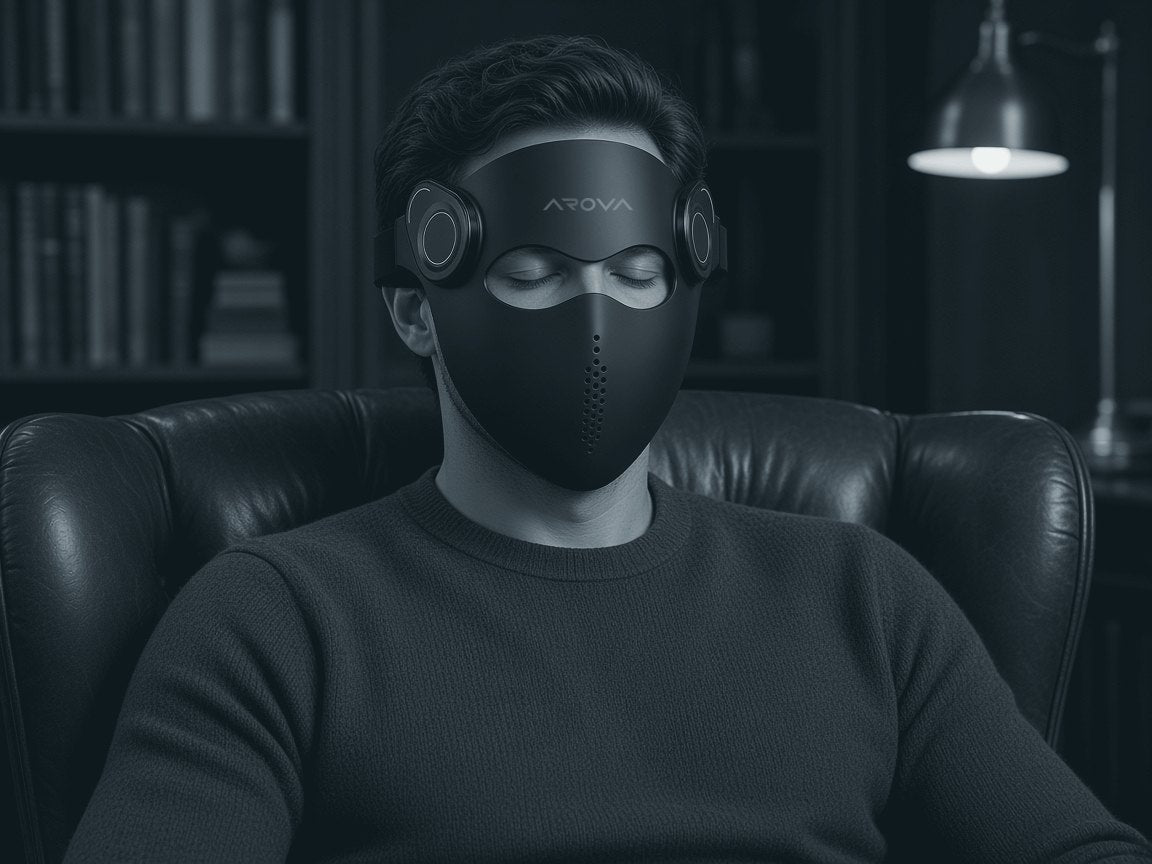
A laser face mask is a wearable device that uses small, low-powered laser diodes, usually alongside LEDs, to deliver red or near-infrared light to the skin. Unlike an LED, a laser emits coherent, tightly focused light, which is why laser face masks raise particular eye-safety questions. Are laser face masks safe? The answer depends on the laser class, the design and how the mask is used. This guide explains the physics, the published science and Australian laser-safety guidance, in plain language.
In brief
- "Low-level" lasers are not the cutting or resurfacing lasers used in clinics; they work at low power.
- Laser and LED masks can share wavelengths. The difference is coherence, beam focus and safety standards.
- Researchers have identified mitochondria as the main site where cells absorb red and near-infrared light, though the mechanism is still debated.
- In Australia, lasers must be labelled with their class, power output and wavelength.
- The word "laser" on a box does not tell you how many laser sources a mask contains.
What is a laser face mask?
There is no single definition. Products sold as laser face masks usually combine small, low-powered laser diodes, LEDs, or both, set into a face-shaped shell. Some contain relatively few laser diodes alongside many LEDs. Others use VCSELs (vertical-cavity surface-emitting lasers), a compact type of laser diode also found in everyday electronics.
What they share is the field of research behind them: photobiomodulation, or PBM, the study of how low-level red and near-infrared light interacts with living cells.
What makes laser light different?
A laser produces light with three distinctive qualities. It leaves the source in a tight, orderly beam (it is collimated). It sits in a very narrow band of colour (it is monochromatic). And its waves move in step with one another (it is coherent).
The field began with lasers. A 2018 review by Heiskanen and Hamblin in Photochemical & Photobiological Sciences explains: "Scientific research into PBM was initially started in the late 1960s by utilizing the newly invented (1960) lasers." At the time, "Collimated, coherent, highly monochromatic beams with the possibility of high power densities were considered preferable."
The phrase "low-level" matters. The lasers studied in this field are not the ablative or resurfacing lasers you may know from clinics. They work at low power, and the light is intended to be absorbed by cells rather than to heat them.
How does a laser face mask work? The science of light and cells
Whether light comes from a laser or an LED, it can only affect a cell if something in that cell absorbs it.
Michael Hamblin of the Wellman Center for Photomedicine at Massachusetts General Hospital writes, in a 2018 review in Photochemistry and Photobiology, that "The primary site of light absorption in mammalian cells has been identified as the mitochondria and, more specifically, cytochrome c oxidase (CCO)." Mitochondria are often described as the energy centres of the cell.
An earlier review by de Freitas and Hamblin, in IEEE Journal of Selected Topics in Quantum Electronics, goes further. Cytochrome c oxidase "contains both heme and copper centers and absorbs light into the near-infra-red region," and "The leading hypothesis is that the photons dissociate inhibitory nitric oxide from the enzyme, leading to an increase in electron transport, mitochondrial membrane potential and ATP production."
Those same authors are candid that the field "has been known for almost 50 years but still has not gained widespread acceptance, largely due to uncertainty about the molecular, cellular, and tissular mechanisms of action." We think that honesty is worth passing on.
Laser vs LED face mask: what is actually different?
This is one of the most searched questions about laser face masks, and the answer is more nuanced than "lasers are stronger".
| Laser | LED | |
|---|---|---|
| Coherence | Coherent | Non-coherent |
| Colour band | Very narrow ("highly monochromatic") | Narrow, slightly broader |
| Beam | Tight, focused point | Wide, even spread |
| Coverage in a mask | Concentrated spots | Overlapping, even coverage |
| Safety standard | Laser safety classes | Lamp and LED photobiological safety |
Wavelength. Both can emit red and near-infrared light, so a laser mask and an LED mask may share the same colours.
Coherence. Whether coherence makes a meaningful difference once light enters tissue is still debated in the literature.
Coverage. A laser concentrates its output into small points. LEDs spread light more evenly across a wide area, which is one reason they suit a full-face shell.
The Heiskanen and Hamblin review records how the field has shifted: "However in recent years, non-coherent light sources such as light-emitting diodes (LEDs) and broad-band lamps have become common." The authors list why: "Advantages of LEDs include no laser safety considerations, ease of home use, ability to irradiate a large area of tissue at once, possibility of wearable devices, and much lower cost per mW."
Read that carefully and it tells you something useful about lasers, too: a focused, coherent beam brings safety considerations an LED does not. For the LED side of the story, see our LED face mask guide.
Are laser face masks safe?
Eyes deserve particular respect around lasers. ARPANSA, the Australian Radiation Protection and Nuclear Safety Agency, is direct: "Lasers can cause damage to the eyes."
Check the label. ARPANSA notes: "It is a legal requirement in Australia for lasers to be labelled according to their particular hazard. This information includes the class of the laser, the power output and the wavelength." Lasers are grouped into classes by their potential to cause harm, with lower classes carrying less hazard.
Do not rely on blinking. ARPANSA explains that "Protection from eye injuries occurs as a result of a human instinct called the 'aversion response'," which includes the natural blink when a bright beam reaches the eye. That is not something to rely on deliberately, and ARPANSA adds a caution: "Australian studies have shown that the labelling applied to laser products does not always reflect the hazard appropriately." Its guidance refers mainly to laser pointers and similar products, but the principle carries across: buy from a brand you trust, and read the label.
Sensible precautions for any laser face mask:
- follow the manufacturer's instructions closely;
- keep your eyes closed, or use eye protection where supplied;
- never look directly into a laser source or point it at anyone's eyes;
- keep devices away from children; and
- speak with your doctor, optometrist or pharmacist before use if you have an eye condition, are pregnant, or take medicines or use products that may increase sensitivity to light.
Choosing a laser face mask in Australia: questions to ask
- How many laser sources, and how many LEDs? "Laser" on the box does not answer this.
- What wavelengths? Look for specific nanometre figures.
- What laser class is on the label? In Australia it should be shown, along with power output and wavelength.
- How is the light directed? Look for a design that keeps light towards the skin, not the eyes, and for supplied eye protection.
- How is it regulated here? You can check whether a device is included in the Australian Register of Therapeutic Goods using the TGA's ARTG search.
- Local support. Fault returns and a seller bound by the Australian Consumer Law.
Reading the research with a clear eye
- Most of the science is about mechanism. Much of what is published describes how cells absorb light, and researchers describe parts of that picture as unsettled.
- Parameters matter. Wavelength, power, distance and session length vary widely between studies.
- Research devices are not consumer devices. The studies above describe light sources in general, not any particular mask.
Frequently asked questions
What is a laser face mask?
A wearable shell that uses low-powered laser diodes, usually combined with LEDs, to deliver red or near-infrared light to the skin. The mix of lasers and LEDs varies widely between products.
Laser vs LED face mask: which is better?
Neither is simply "better". Both can emit similar wavelengths. Lasers are coherent and focused, while LEDs spread light evenly over a wide area. Researchers note that LEDs carry "no laser safety considerations", whereas lasers must meet laser safety requirements.
Are laser face masks safe?
Low-level laser face masks are designed for home use, but lasers can harm the eyes. In Australia, lasers must be labelled with their class, power output and wavelength. Follow the instructions, protect your eyes, and check with a health professional first if you have an eye condition, are pregnant or are light-sensitive.
Is a laser face mask the same as a clinic laser?
No. Clinic lasers used for resurfacing work at far higher power and are designed to heat or remove tissue. Laser face masks use low-level light intended to be absorbed, not to heat.
How do I know how many lasers a mask has?
Check the specifications for the number of laser diodes, the number of LEDs, the wavelengths and the laser class. If a brand cannot tell you, that tells you something too.
A note from Arova
At Arova, we believe beauty tools deserve the same honesty as the research behind them. We designed this guide to inform, not to sell. A higher standard of beauty tools begins with a clear view of the science.
This article is general information only and is not medical advice. The research referred to was not conducted on Arova devices, and its findings should not be taken to apply to Arova products. Please speak to a doctor or other qualified health professional before using any light-based device, particularly if you have a skin or eye condition, are pregnant, or take medication that may affect light sensitivity.
References
- Heiskanen V, Hamblin MR. Photobiomodulation: lasers vs. light emitting diodes? Photochem Photobiol Sci. 2018;17(8):1003–1017. https://pubmed.ncbi.nlm.nih.gov/30044464/
- Hamblin MR. Mechanisms and mitochondrial redox signaling in photobiomodulation. Photochem Photobiol. 2018;94(2):199–212. https://pubmed.ncbi.nlm.nih.gov/29164625/
- de Freitas LF, Hamblin MR. Proposed mechanisms of photobiomodulation or low-level light therapy. IEEE J Sel Top Quantum Electron. 2016;22(3):7000417. https://pubmed.ncbi.nlm.nih.gov/28070154/
- Australian Radiation Protection and Nuclear Safety Agency (ARPANSA). Lasers. https://www.arpansa.gov.au/understanding-radiation/radiation-sources/more-radiation-sources/lasers